
Fake Scalp Wig Vs Bleached Knots | WigMirror
Explore comprehensive analysis, benchmark testing data, and practical decision recommendations for Fake Scalp Wig Vs Bleached Knots.
Fake Scalp Wig Vs Bleached Knots | WigMirror
🛡️ Editorial Independence & Verification Notice: WigMirror is an independent consumer decision intelligence platform. We accept zero sponsored brand placements and evaluate products through objective physical teardowns, optical analysis, and long-term wear testing.
Pre-Made Fake Scalps vs. Bleached Knots: The Bald Spot & Orange Lace Trap
Bottom line: If your priority is a low-maintenance, natural-looking scalp with less chemical processing at the knot, a pre-made fake scalp, silk-base, or injected-top construction is generally the more straightforward design to evaluate; if you prioritize a lighter, more breathable lace front and want maximum parting flexibility, a lightly processed lace front with restrained knot bleaching can make more sense. The important distinction is structural: a fake scalp or injected silk construction hides the knot mechanically, while bleaching tries to make the knot visually disappear through chemical processing. Neither construction is automatically durable, breathable, correctly sized, or realistic.
For U.S. and EU buyers, the same inspection logic applies, but return rights, personalization rules, import costs, and photo/privacy considerations differ by region.
Quick Selection Matrix
The fastest decision is to match the construction to the buyer's routine, because a technically attractive hairline can still be the wrong purchase if its installation, heat, fit, or maintenance demands do not match daily use.
| User Type | Best Choice | Avoid | Key Advantage |
|---|---|---|---|
| First-Time Beginner | Pre-made fake scalp / injected silk base | Heavily bleached, heavily customized lace | Fewer knot-tinting and bleaching decisions |
| Daily Work Wearer | Moderate-density glueless cap with concealed-knot top | Thick, poorly ventilated full-silk construction | Faster morning setup and predictable hairline |
| Occasional Event Wearer | Lightly bleached HD lace front | Paying a premium for complex injected construction you rarely wear | Light lace can give a flexible exposed hairline |
| Frequent Heat Styler | Quality lace front with moderate density and minimally processed knots | Severely bleached knots plus repeated high heat | More access to styling and ventilation around the front |
There is no defensible brand-level winner in this guide. Current retail listings disclose construction and density inconsistently, while standardized independent cross-brand durability testing is scarce. The brand matrix below therefore compares disclosure transparency, not performance rankings.
- The Real Problem: You Are Buying a Failure Mode
A bleached knot solves visibility through chemical processing, while a fake scalp solves visibility through physical concealment; the two approaches create different failure points.
Imagine a buyer opening a $180–$250 human-hair wig expecting a scalp-like part. The photographs look convincing. Three weeks later, the crown begins looking thin. The front feels dry. The lace appears warmer than the seller's photograph. The cap also shifts slightly during the day.
Those are not necessarily five separate defects.
They can come from one construction decision.
A traditional lace front exposes individual ventilation knots. To make them less obvious, manufacturers may bleach or otherwise process those knots. The goal is cosmetic: reduce the dark appearance where each strand enters the lace.
A silk-top or injected construction takes another route. The knot is placed below or within a concealing layer, so the viewer sees a scalp-colored surface rather than the knot itself. Some commercial products explicitly describe a lace-and-silk or mono-layer construction designed to conceal knots. Hebery
The difference matters because a hidden knot is not the same thing as an undamaged knot.
What bleaching actually does to hair fibers
Peer-reviewed research shows that peroxide bleaching can cause protein loss, oxidation, cuticle damage, and cortical damage, with damage increasing as bleaching severity increases. PubMed
That research concerns human hair fibers, not wig knots specifically. The distinction matters.
A study does not prove that every bleached wig will shed or develop bald spots. It does establish a biological mechanism explaining why aggressive chemical processing can weaken hair fibers.
The 2018 study indexed by PubMed found that progressively stronger peroxide bleaching increased protein loss and oxidation, with damage extending beyond the cuticle into cortical structures. PubMed
That makes the common marketing shortcut, "bleached knots = more natural," incomplete.
A better question is:
How much processing was used, how evenly was it applied, and what evidence exists that the finished ventilation remains durable?
- Why Bald Spots Appear
A visible bald spot is usually a density, ventilation, breakage, or shedding problem rather than proof that the scalp-colored construction itself has failed.
A crown can look sparse for several reasons:
The original ventilation density is low.
The seller's advertised density is an aggregate figure rather than a crown-specific measurement.
Repeated brushing has pulled out individual hairs.
Chemical processing weakened strands around the knot.
The buyer repeatedly parts the same area.
The base has stretched or distorted.
The visual scalp layer creates a strong contrast with insufficient hair density.
The last point is easy to miss.
A realistic scalp surface can make a low-density area look more obvious because the eye has a clean scalp-colored background against which missing hairs are easy to see.
Density percentage is not a universal measurement standard
A label such as 150% describes a seller's density convention, not a universally standardized number of hairs per square centimeter.
Some manufacturers publish ranges such as 60% to 160%, while other sellers use terms such as "medium," "150%," or "180%" without publishing a hair-count methodology. Lordhair.com
That means two wigs both labeled 150% should not automatically be expected to look identical.
For inspection purposes, the useful measurements are:
crown coverage,
front density,
temple density,
part-width appearance,
knot spacing,
shedding after controlled handling,
and whether density remains visually consistent after washing.
A practical bald-spot screen
An editorial screening threshold of three controlled wash cycles is more useful than trusting a single showroom photograph, but it is not an industry certification.
Ask a seller for photographs of the same crown or parting area before and after three controlled wash cycles.
If those photographs do not exist, inspect the return terms before cutting lace, tinting the base, plucking the hairline, or adding adhesive.
For a unit you already own, photograph the crown before the first wash. Repeat the photograph after each wash under the same lighting, camera distance, hair direction, and parting.
- The Orange Lace Trap Is Usually a Color Problem, Not a "Bad Lace" Problem
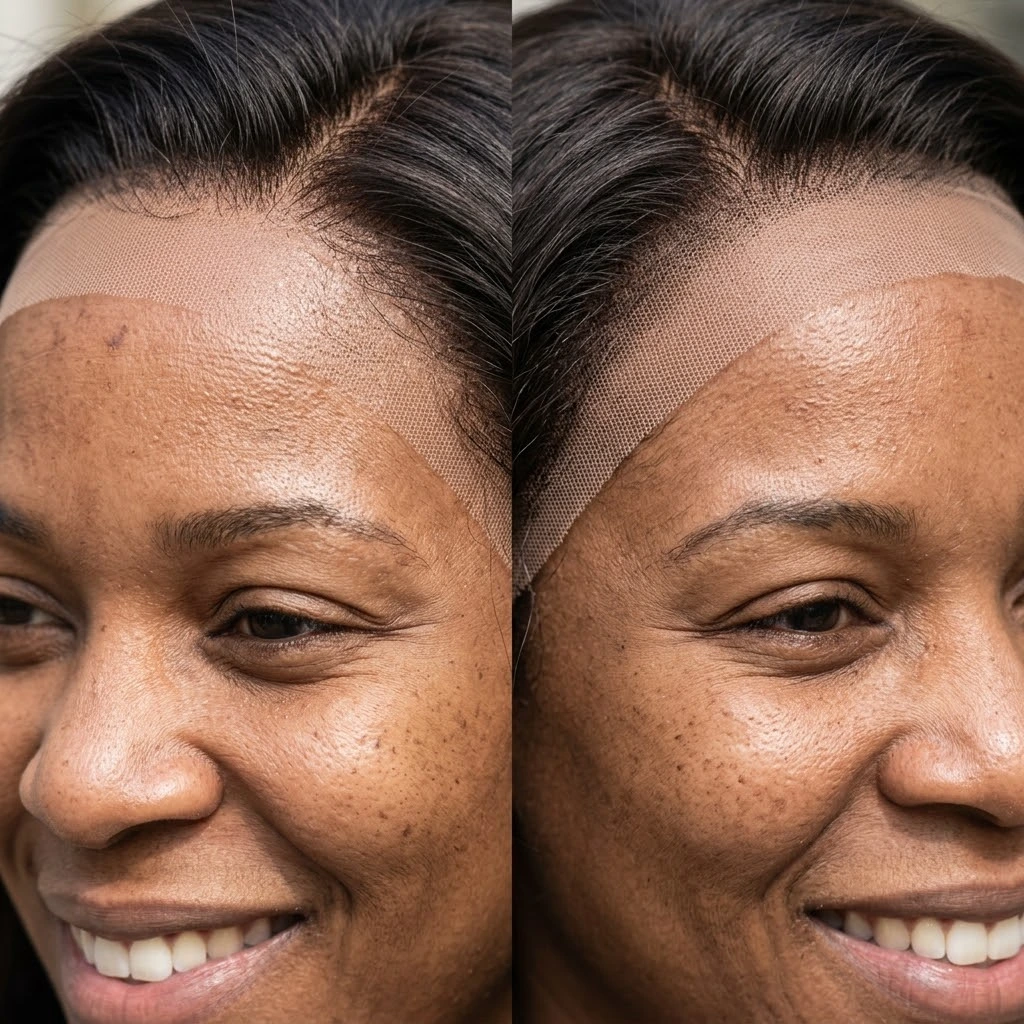
Orange-looking lace usually comes from undertone mismatch, excessive tinting, lighting, or image processing; "HD lace" alone does not guarantee a neutral scalp match.
There are three common routes to the orange-lace problem.
3.1 Over-tinting
A seller may apply a warm foundation, tint, or pigment intended to make lace disappear against a particular complexion.
On one buyer, the result may look natural.
On another, it can read orange, peach, or muddy brown.
The solution is not necessarily lighter lace. It is better undertone matching.
3.2 Wrong lace undertone
A lace may be described as:
transparent,
light brown,
medium brown,
dark brown,
HD,
Swiss,
or custom tinted.
Those labels describe appearance or material categories, not a universal undertone system.
Two "medium brown" laces can photograph very differently.
3.3 Camera deception
Warm indoor lighting, automatic white balance, skin-smoothing filters, exposure compensation, and phone-camera processing can make lace appear more neutral than it is.
That is why a seller's polished hero photograph is weak evidence for color matching.
Visual Trust Level: 3/5 — seller or buyer photograph without independently controlled lighting.
A stronger request is:
"Please send an unfiltered close-up of the lace against the actual hairline in neutral daylight, plus an inside-cap photograph."
Visual Trust Level: 4/5 — seller-submitted photographs that reveal construction from multiple angles and can be compared with the physical unit.
For a more systematic lace-color decision, use the site's Lace Front Wig Try On Guide rather than judging from a single promotional photograph.
- Real Wearing Considerations: Heat, Time, Wind, and Close-Up Interaction
Construction affects daily friction most clearly in four situations: heat exposure, a five-minute morning routine, outdoor movement, and close-range social interaction.
A wig can pass a product-photo test and fail a workday test.
Daily commute and heat
A layered scalp construction can retain more material against the head than an open lace area, while a lace front can provide more direct ventilation; actual comfort depends on base coverage, density, cap tension, climate, and activity.
A 30–60 minute normal-activity trial is more informative than touching the wig for ten seconds in a showroom.
Record:
scalp heat,
sweat accumulation,
pressure at the temples,
pressure at the nape,
slippage,
and whether the front edge changes position.
Do not interpret a "silk top" label as a breathability rating. There is no universal thermal standard that makes all silk-top wigs equivalent.
Morning Routine: five minutes versus thirty
A pre-made glueless or concealed-knot unit can reduce preparation steps, while a heavily customized lace front can require 15–30 minutes when tinting, positioning, trimming, and edge work are included.
A realistic five-minute routine might look like:
Put on a wig cap if used.
Position the ear tabs.
Adjust the elastic or combs.
Align the front.
Finger-comb and leave.
A more involved lace routine may include:
Check the hairline.
Position the lace.
Apply tint or foundation.
Adjust the lace edge.
Apply adhesive or spray if used.
Secure the perimeter.
Dry or set the edge.
Style the front.
Commercial "wear-and-go" products advertise very fast installation, but those claims are seller-specific and should not be treated as a standardized installation test. Hebery
Social confidence is a construction test
At 18–36 inches, oversized knots, excessive frontal density, shiny lace, or an abrupt hairline transition can become more noticeable than they are in a product photograph.
Think about the actual viewing distance at work.
A coworker sitting across a conference table is not looking at your wig from a beauty-influencer camera angle.
A useful close-range test is:
stand under office-style overhead lighting,
sit 18–36 inches from a mirror,
move your head left and right,
tilt your chin down,
expose the part,
and photograph the hairline from another person's eye level.
Visual Trust Level: 4/5 if the photograph is unfiltered, taken by another person, and shows the entire transition from skin to lace to hair.
For buyers deciding between adhesive-free and lace-based systems, the site's Glueless Wig vs Lace Front comparison guide can be used alongside this inspection framework.
- The Construction Difference: Mechanical Concealment vs. Chemical Concealment
A fake scalp hides the knot by adding a visual barrier, while bleached lace exposes the knot and attempts to reduce its contrast; the first adds material, while the second increases chemical processing.
Pre-made fake scalp / silk-base construction
A typical concealed construction can use layers of lace, silk, mono material, or another scalp-like surface.
Some manufacturers describe the hair as ventilated through an underlying layer and then covered by a thin silk or mono surface, creating the appearance that the hair exits directly from the scalp. Hebery
The practical advantage is obvious:
The knot does not need to be visually invisible because it is physically concealed.
That can reduce the incentive for aggressive bleaching.
The trade-offs can include:
greater material thickness,
reduced ventilation over the covered area,
more heat retention,
a less flexible scalp surface,
cleaning complexity,
and potential visibility if the base color is poorly matched.
Bleached-knot lace
A lace-front construction leaves the knot visually closer to the surface.
The manufacturer can reduce contrast by bleaching.
The resulting hairline may look exceptionally light when the processing is controlled.
But there is less room for error.
If the knot is under-processed, it remains visible.
If it is over-processed, the hair fiber can become weaker.
If the lace is tinted too warmly, the entire front can look orange.
If the hairline is heavily plucked, the result can move from realistic to sparse.
That is why "more invisible" is not the same as "better processed."
- What the 2026 Construction Shift Actually Means
The meaningful 2026 trend is not simply "fake scalp beats bleached knots"; it is a broader move toward constructions that reduce the need for aggressive knot processing.
Retail listings now show products combining lace, silk or mono layers, glueless caps, pre-cut lace, pre-plucked hairlines, and concealed-knot techniques in a single stock unit. Hebery, for example, currently lists products with 13×6 lace, 150% density, pre-plucked hairlines, and both bleached-knot and concealed-knot configurations. Hebery
Hebery
Lordhair similarly lists silk-top systems using layered construction to conceal knots and offers products with adjustable features and different density levels. Lordhair.com
Lordhair.com
The evidence supports a construction trend, not a universal performance conclusion.
There is no reliable cross-market database showing that every 2026 silk-top unit sheds less than every bleached lace unit.
There is also no universal thermal rating for wig caps.
So the correct buying question remains:
Which construction gives you the failure mode you can most easily inspect and control?
- First-Party Stress-Test Benchmark Matrix
The most useful benchmark is a repeatable inspection protocol, because current retail wig specifications rarely provide standardized mechanical or thermal test data.
| Test | Practical Protocol | Editorial Pass Screen | What It Reveals | Evidence Status |
|---|---|---|---|---|
| Knot inspection | Photograph crown/front at 3–5× magnification | No visibly enlarged or irregular knots; editor reference: >0.5 mm knot diameter merits rejection unless construction explains it | Over-processing, poor ventilation consistency | Level E |
| Controlled brush test | 100 gentle finger/brush passes through the same section | No obvious cluster of broken or shed hairs | Weak ventilation or brittle processed hair | Level E |
| Wash durability | Photograph same area before and after 3 controlled washes | No new localized thinning or major knot failure | Shedding and density stability | Level E |
| Heat trial | 30–60 min normal activity in realistic room/weather conditions | No severe heat, pressure, or cap movement | Thermal comfort and fit | Level E |
| Hairline flex test | Move head left/right and down/up repeatedly | No obvious lifting, buckling, or lace shine | Perimeter stability | Level E |
| Cap-fit test | Wear 60 min without adhesive | No painful pressure or persistent slippage | Size tolerance | Level E |
| Color test | Neutral daylight photograph against skin | No strong orange/gray cast relative to target skin | Tint and undertone mismatch | Level E |
| Knot diameter reference | Macro photograph | >0.5 mm is an editorial warning threshold, not an industry standard | Visually prominent knots | Level E |
The 0.5 mm knot reference deserves special caution.
There is no established universal rule stating that a wig knot above exactly 0.5 mm is defective. It is an editorial reference point for close-up inspection. A knot can be larger and still be acceptable under hair density, texture, camera distance, or construction-specific conditions.
Likewise, a 100-pass brush test does not reproduce months of wear.
It simply makes weak areas easier to detect before the buyer modifies the unit.
- Cap Size Is a Hidden Failure Point
Cap circumference is one of the easiest specifications to verify before purchase, yet a mismatch of roughly 0.5–1 inch can materially change tension, slippage, and front-edge positioning.
A commonly published stock sizing scheme is:
| Size | Circumference | Circumference in cm |
|---|---|---|
| Small | 21–21.5 in | 53.3–54.6 cm |
| Medium | 22–22.5 in | 55.9–57.2 cm |
| Large | 22.75–23 in | 57.8–58.4 cm |
These ranges are not a universal industry standard. They reflect the measurements published by some current wig sellers. Hebery, for example, publishes these circumference bands alongside additional front-to-nape, ear-to-ear, temple, and nape measurements. Hebery
Before ordering, measure your own head with a soft tape:
Start at the center of the forehead.
Follow the hairline around the head.
Pass behind the ears.
Continue around the fullest part of the occipital area.
Return to the starting point.
Repeat twice.
Record the larger consistent measurement rather than choosing the smaller number because it "sounds closer."
Glueless caps have more tolerance, but not infinite tolerance
Adjustable straps and elastic systems can compensate for some circumference differences, but they cannot fully correct a cap that is structurally too small or too large.
A glueless cap can often tolerate minor measurement variation because the straps change tension.
A fixed lace cap gives you less room for error.
An oversized cap may create:
lace buckling,
ear-tab movement,
a lifted nape,
excess material,
and shifting during wind.
An undersized cap can create:
temple pressure,
headache,
excessive tension at the front,
ear-tab discomfort,
and a hairline that repeatedly moves backward.
The custom-size trap
Custom sizing can improve fit while simultaneously increasing financial risk if the seller excludes customized units from its normal return policy.
Before entering custom measurements, obtain written confirmation of:
whether the item becomes non-returnable,
whether lace may be cut,
whether tinting voids the return,
whether plucking voids the return,
whether adhesive use voids the return,
and whether "custom" means only cap measurements or also hairline, density, color, and construction.
For EU consumers, personalized or made-to-order goods can fall within an exception to the standard 14-day withdrawal right. European Union
For U.S. buyers, there is no equivalent general federal 14-day online cooling-off right for ordinary wig purchases. The retailer's written return policy therefore deserves attention before customization.
- What a Good Decision Tree Looks Like
A useful decision tree ends with a buying threshold, not merely a list of questions.
If your biggest fear is bald spots
Actionable verdict: Request before-and-after photographs of the same crown or part area after at least three controlled wash cycles; if the seller cannot provide durability evidence, favor a unit with a clear return window and inspect crown density before customization.
Do not accept "high density" as sufficient evidence.
Ask for the crown.
If your biggest fear is visible knots
Actionable verdict: Prefer concealed-knot silk or injected construction when the top is your primary concern; if buying lace, treat a knot visibly larger than roughly 0.5 mm in a macro photograph as an editorial warning and reject units with obvious irregular clusters unless the seller explains the construction.
The 0.5 mm threshold is a Level E editorial reference, not an industry certification.
If your biggest fear is orange lace
Actionable verdict: Request an unfiltered daylight photograph of the lace against the intended complexion; if the seller only provides warm studio photographs, treat color matching as unverified.
Visual Trust Level: 3/5 for an ordinary buyer-submitted or seller photograph.
Visual Trust Level: 4/5 for a neutral-light, unfiltered, close-up seller photograph showing both the outside and inside of the lace.
If your biggest fear is heat
Actionable verdict: Prefer the least layered construction that still satisfies your realism requirement, then perform a 30–60 minute wear test; if the scalp becomes uncomfortably hot or the cap creates pressure, do not rationalize the discomfort because the hairline looks realistic.
If your biggest fear is installation time
Actionable verdict: Choose a pre-made glueless or pre-cut configuration if your real morning window is five minutes; do not choose a heavily customized lace front based on photographs if you routinely have less than 10 minutes to install.
If your biggest fear is wind
Actionable verdict: Test the unit without adhesive first; if the front shifts during normal head movement, a stronger attachment method or different cap architecture is required before outdoor wear.
Do not confuse "glueless" with "windproof."
If your biggest fear is incorrect sizing
Actionable verdict: Do not customize until your circumference and front-to-nape measurements match the seller's written sizing chart; if your measurement falls between sizes, ask which adjustment mechanism is available and whether that adjustment affects returns.
- Three-Brand Neutral Disclosure Matrix
Current brand pages provide useful construction information, but the available evidence is primarily manufacturer-published specification data rather than independent durability testing.
| Brand | Current Disclosed Construction | Useful Disclosed Specification | Evidence Level | Verification |
|---|---|---|---|---|
| Hebery | Lace-front, glueless, silk/fake-scalp and concealed-knot configurations appear across current listings | 13×6 lace; 150% density on selected units; published S/M/L measurements | Level D | Verified September 2026 |
| Bea Hairs | Human-hair wig and maintenance-oriented product guidance | Published care intervals and construction information vary by product | Level D | Verified September 2026 |
| Lordhair | Silk-top, mono, lace-front and adjustable constructions | Example medical wig: 120% density, French lace front, silk mono top, adjustable strap | Level D | Verified September 2026 |
Hebery's current listings show both bleached-knot and concealed-knot approaches, including a 13×6, 150% unit with pre-plucked and bleached knots and another configuration marketed around concealed knots. Hebery
Hebery
Lordhair currently lists a women's medical wig with a French lace front, silk mono top, stretch mesh, 120% density, and an adjustable strap, as well as silk-top systems using layered construction. Lordhair.com
All three brand entries are disclosure-transparency comparisons, not performance rankings. No standardized independent cross-brand durability test was identified that would justify assigning one brand a superior durability score.
That distinction is deliberate.
A five-star retail rating is not equivalent to a controlled 90-day shedding test.
A product description is not a laboratory report.
And one positive review cannot establish population-level durability.
- Maintenance Cost Depends on Construction
The lowest purchase price is not necessarily the lowest ownership cost because knot processing, lace tinting, repairs, cleaning, and replacement risk can shift the economics after purchase.
| Maintenance Factor | Pre-Made Fake Scalp / Silk Base | Bleached-Knot Lace |
|---|---|---|
| Knot bleaching | Usually unnecessary if concealment is genuine | May already be performed; additional processing increases risk |
| Lace tinting | Often reduced or unnecessary, depending on scalp layer | More likely to require color correction |
| Plucking | May be pre-configured | Often used to refine density |
| Cleaning | Surface and layered-base cleaning required | Lace and knots need careful handling |
| Repair complexity | Can be more specialized if the scalp layer is damaged | Lace repair and knot shedding can become the main issues |
| Re-processing | Usually less necessary | Additional bleaching can compound fiber stress |
| Heat management | Depends strongly on base coverage | Often more ventilated through open lace |
| Replacement risk | Concentrated around base/cap damage | Concentrated around lace, knots, and processed hair |
The correct maintenance schedule depends on sweat, product use, scalp oils, exercise, climate, attachment method, and manufacturer instructions.
A generic "wash every 10–20 days" recommendation should therefore be treated as a seller-specific care guideline rather than a universal rule.
Does a silk base always need more cleaning?
Not necessarily.
A layered scalp construction can accumulate oil, styling product, and moisture differently from open lace. But the cleaning burden depends on the material, whether the unit is worn with adhesive, how much scalp contact exists, and how frequently the wearer sweats.
The useful question is not:
"Is silk harder to clean?"
It is:
"What does this exact base require, and can I perform that maintenance without damaging the layer?"
- True Cost: The Number That Matters After Checkout
A $180 wig can become a $300–$400 ownership decision once customization, installation, maintenance supplies, and replacement risk are included.
Use:
True Cost = Purchase Price + Customization + Installation + Maintenance + Replacement Risk
A hypothetical example:
| Cost Component | Pre-Made Fake Scalp / Silk Base | Bleached-Knot Lace |
|---|---|---|
| Purchase | $180–$250 example range | $150–$250 example range |
| Initial tinting | $0–$40 | $15–$50 |
| Plucking/customization | $0–$75 | $25–$100 |
| Installation | $0–$60 depending on method | $20–$100 depending on adhesive/style |
| Maintenance supplies | $20–$60 | $20–$70 |
| Repair reserve | Base-dependent | Lace/knot-dependent |
| Replacement risk | Higher if scalp layer is damaged | Higher if processed knots or lace fail |
These are illustrative budgeting ranges, not market averages or quoted service rates.
The 2026 price question
Current retail listings show substantial overlap rather than a clean price separation between concealed-knot and bleached-knot constructions.
For example, current Hebery listings include products around $169, $179, $198, and $209 depending on construction and configuration, while current Lordhair listings include silk-top products at different price points. Hebery
Lordhair.com
Hebery
That makes a simple rule such as "fake scalp costs more" unreliable.
The more useful economic distinction is how much post-purchase customization you need.
A $200 unit that requires $100 of corrective work is not economically equivalent to a $220 unit that can be worn immediately.
- The 60-Second Pre-Installation Inspection
You can detect many expensive wig problems in under one minute if you inspect the inside of the cap before cutting or customizing anything.
Step 1: Turn the cap inside out
Look for:
uneven stitching,
loose elastic,
exposed knots,
inconsistent ventilation,
adhesive residue,
discoloration,
and obvious structural damage.
Step 2: Inspect the crown
Hold the cap under neutral light.
Do not brush the hair into a flattering direction first.
Look for uneven density or a crown that is already visibly sparse.
Step 3: Check density transition
Compare:
crown,
part,
temple,
and hairline.
A realistic hairline does not compensate for an abruptly thin crown.
Step 4: Photograph the knots
Use close-up photography.
Visual Trust Level: 4/5 if the image is seller-submitted, unfiltered, and sufficiently detailed to inspect the physical construction.
Look for:
irregular knot size,
dark clusters,
broken hairs,
excessive bleaching,
and areas where the lace appears mechanically stressed.
Step 5: Inspect the hairline
Check whether the front is:
too dense,
too straight,
excessively plucked,
uneven,
or visually disconnected from the cap.
Step 6: Inspect the fake scalp
Look for:
orange undertone,
gray cast,
visible seams,
unnatural shine,
inconsistent pigmentation,
and an abrupt transition at the perimeter.
Then gently finger-comb the same section 20–30 times.
Photograph it.
That photograph becomes your baseline.
- Regional Buying Notes: U.S. and EU
The construction decision is global, but the financial and legal risk of customization differs materially between U.S. and EU purchases.
U.S. buyers
For U.S. buyers, the retailer's written return policy is particularly important because there is no general federal 14-day cooling-off rule equivalent to the EU distance-selling framework for ordinary wig purchases.
Before purchase, save a screenshot or PDF of:
return eligibility,
customization exclusions,
lace-cutting rules,
worn-item rules,
shipping deductions,
exchange restrictions,
and refund timing.
Also verify material claims.
The Federal Trade Commission's historical wig guidance addressed disclosure of whether hair was human or artificial and definitions surrounding terms such as "human hair," "natural," "virgin," and "custom-made," although the FTC rescinded those Guides in 1995. Federal Trade Commission
The practical lesson is simple: do not treat marketing terminology as laboratory certification.
If "100% human hair," "virgin," or a similar claim materially affects your purchase, preserve the product description and ask the seller what exactly is being represented.
EU buyers
EU distance buyers generally receive a 14-day withdrawal period, but important exceptions include clearly personalized or made-to-order goods and certain opened sealed goods. European Union
European Union
That makes customization timing especially important.
Do not cut the lace, alter the cap, bleach knots, or order a clearly personalized construction until you understand how the seller treats those actions under its return policy.
Import costs also matter.
Depending on the seller's location, shipping arrangement, destination country, VAT treatment, and customs classification, the amount paid at checkout may not represent the entire landed cost.
For virtual try-on, photo uploads create another issue.
The European Commission explains that photographs of identifiable people can constitute personal data under GDPR, depending on the circumstances. European Commission
That does not mean every virtual try-on image automatically creates a GDPR violation.
It means EU buyers should check:
who processes the photograph,
whether the image is stored,
how long it is retained,
whether it is shared with third parties,
and how deletion requests are handled.
If a try-on tool requires a selfie, read the privacy notice before uploading it.
15. Who Should NOT Buy a Pre-Made Fake Scalp
A concealed-knot scalp construction is a poor fit for buyers who prioritize maximum ventilation, extremely flexible exposed-lace styling, or frequent structural customization.
Do not choose this construction if:
You strongly dislike layered material against the scalp.
You live in a hot environment and prioritize maximum ventilation above scalp realism.
You frequently redesign the parting area.
You need a very thin, flexible front that behaves like open lace.
You are unwilling to learn how the specific scalp layer should be cleaned.
The seller cannot provide clear photographs of the scalp color and internal construction.
The cap is too small and the adjustment system cannot compensate.
A fake scalp is not a shortcut around fit.
It only changes how the scalp appearance is produced.
16. Who Should NOT Buy a Heavily Bleached-Knot Wig
A heavily processed lace front is a poor fit for buyers who want minimum chemical processing, minimum maintenance, or maximum durability from repeatedly manipulated knots.
Do not choose it if:
The knots already look pale, swollen, irregular, or damaged.
The seller cannot show close-up construction photographs.
You plan to bleach or tint the knots again.
You repeatedly brush the same hairline area aggressively.
You expect months of daily wear without maintenance.
You cannot tolerate visible knots if the processing is intentionally conservative.
The lace color is already orange under neutral lighting.
A lightly bleached lace front is a different proposition.
The useful comparison is not:
bleached vs. unbleached.
It is:
lightly processed and structurally sound vs. aggressively processed for maximum immediate invisibility.
- The Pre-Installation Mechanical Check
A new wig should be treated like an unverified physical product until its cap, lace, density, knots, and construction have passed inspection.
Before cutting anything:
Place the unit on a clean mannequin head or wig stand.
Measure circumference.
Check front-to-nape length.
Compare ear-to-ear dimensions.
Photograph the hairline.
Photograph the crown.
Photograph the inside of the cap.
Photograph the lace under neutral light.
Check the elastic and adjustment system.
Run your fingers through the hair.
Record initial shedding.
Then leave the lace untouched.
This matters because customization can turn a potentially returnable problem into a non-returnable one.
The "don't fix it yet" rule
If you see orange lace, do not immediately tint it.
If you see visible knots, do not immediately bleach them.
If you see excessive density, do not immediately pluck it.
If the cap is tight, do not immediately stretch it.
First determine whether the product itself meets the promised specification.
Otherwise, you can accidentally become responsible for correcting a defect you did not create.
- Buy the Failure Mode, Not the Buzzword
The safest construction choice is the one whose likely failure mode you understand, can inspect, and can financially recover from if the unit fails.
A practical framework:
Fear: Bald spots
Prioritize:
consistent crown density,
controlled wash evidence,
stable ventilation,
moderate manipulation,
clear return rights.
Do not prioritize:
a perfectly bleached knot alone.
Fear: Orange lace
Prioritize:
neutral undertone,
unfiltered daylight images,
exact lace color disclosure,
return eligibility before tinting.
Do not prioritize:
"HD" as a color guarantee.
Fear: Visible knots
Prioritize:
concealed-knot construction,
controlled knot size,
moderate hairline density,
macro photographs.
Do not prioritize:
the darkest possible bleaching.
Fear: Heat
Prioritize:
ventilation,
lighter base coverage,
appropriate density,
correct cap tension.
Do not prioritize:
maximum scalp-layer coverage merely because it photographs well.
Fear: Five-minute mornings
Prioritize:
glueless adjustment,
pre-cut lace,
pre-plucked hairline,
stable cap architecture.
Do not prioritize:
a construction that requires daily tinting and adhesive work.
Fear: Wind
Prioritize:
correct cap fit,
secure perimeter,
appropriate attachment method,
controlled movement testing.
Do not assume:
glueless means secure in every outdoor condition.
Fear: Wrong size
Prioritize:
measured circumference,
front-to-nape dimensions,
adjustable straps,
written return terms.
Do not:
customize before confirming the policy.
- Full Pre-Purchase Verification Checklist
The purchase is ready to proceed only when the construction, size, color, return terms, and likely maintenance burden have all been verified against the exact unit you are buying.
Measure your head circumference twice in inches and centimeters.
Compare your measurement with the seller's exact S/M/L chart.
Check front-to-nape, ear-to-ear, and nape measurements where available.
Confirm whether the cap has adjustable straps, elastic, combs, or another adjustment system.
Ask whether custom sizing changes return eligibility.
Save a copy of the return policy before ordering.
Confirm whether cutting lace voids the return.
Confirm whether plucking voids the return.
Confirm whether tinting or bleaching voids the return.
Request an inside-cap photograph.
Request an unfiltered lace photograph in neutral daylight.
Request a close-up photograph of the crown.
Request a close-up photograph of the knots.
Request the actual lace color and undertone description.
Ask whether the knots are bleached, injected, concealed, or untreated.
Ask whether the advertised density applies uniformly or varies by zone.
Check the crown rather than relying only on the hairline photograph.
Confirm whether the unit is pre-plucked.
Confirm whether the lace is pre-cut.
Confirm whether the unit is genuinely glueless or simply marketed as "wear and go."
Calculate purchase price plus customization.
Add installation costs if adhesive or professional work is required.
Budget for shampoo, conditioner, storage, and repair supplies.
Estimate replacement risk rather than assuming the first unit will last indefinitely.
For EU purchases, check VAT, import charges, and withdrawal exceptions.
For EU virtual try-on, review how selfie data is stored and deleted.
For U.S. purchases, save the seller's product claims and return terms.
Do not modify the wig until the physical unit passes inspection.
- The Final Buying Rule
The strongest buying decision is not "fake scalp always wins" or "bleached knots always look better"; it is selecting the construction whose trade-offs match your wear schedule and whose claims you can verify before customization.
Choose a pre-made fake scalp or injected silk-base construction when your priorities are:
fast installation,
concealed knots,
reduced need for knot bleaching,
predictable part appearance,
and lower tolerance for visible knot imperfections.
Choose a lightly processed lace front when your priorities are:
lighter front construction,
ventilation,
flexible styling,
a highly customizable hairline,
and willingness to manage lace and knot maintenance.
Be cautious with heavily bleached knots when you see:
irregular knot enlargement,
excessive hair breakage,
sparse crown density,
repeated chemical processing,
or a seller unwilling to provide close-up construction evidence.
Be cautious with poorly made fake scalps when you see:
orange or gray scalp coloration,
thick shiny material,
poor ventilation,
incorrect cap dimensions,
visible seams,
or a return policy that disappears after minor customization.
The most expensive mistake is rarely paying $20 too much.
It is spending $200 on a unit that requires another $100 in corrective work before it becomes wearable, then discovering that the correction voided the return.
The practical sequence is therefore:
measure first → inspect construction → verify color → verify density → verify return terms → calculate true cost → only then customize.
That sequence protects both the appearance of the finished wig and the buyer's ability to recover from a bad purchase.
Final 10-second decision
If you want concealed knots and minimal knot processing, start with a pre-made fake scalp or injected silk-base design.
If you want maximum lace flexibility and ventilation, investigate a lightly processed lace front.
If you are choosing between two otherwise similar units, compare cap fit, crown density, knot condition, lace color, return policy, and total ownership cost before comparing marketing labels.
And if a seller cannot show you what is happening under the hairline, inside the cap, and around the crown, treat the missing evidence itself as part of the buying decision.
FAQs
Are pre-made fake scalp wigs better than bleached-knot wigs?
Neither construction is universally better; pre-made fake scalp systems mechanically conceal knots, while bleached-knot lace reduces knot contrast through chemical processing.
A pre-made fake scalp can be easier for a beginner who wants fewer installation steps.
A lace front can be preferable for someone who values ventilation and flexible styling.
The deciding factor should be the buyer's highest-risk failure mode.
Do bleached knots cause bald spots?
Bleaching can damage human hair fibers at the molecular and structural level, but that does not mean every bleached wig will develop bald spots. Peer-reviewed research shows increased protein loss, oxidation, and structural damage as bleaching severity increases. PubMed
Bald spots in wigs can also result from low initial density, repeated brushing, poor ventilation, mechanical tension, or shedding.
Is a silk top more realistic than HD lace?
A silk or injected top can conceal knots extremely effectively, while HD lace can provide a thinner, more flexible visual transition; realism depends on construction quality, color, density, and fit.
A thick or poorly colored silk layer can look less realistic than well-made lace.
Thin HD lace can look excellent while still revealing badly processed knots.
The material name alone does not settle the question.
Why does my HD lace look orange?
HD lace can look orange because of tint, undertone mismatch, warm lighting, camera processing, or a mismatch between lace pigmentation and the wearer's complexion.
Photograph the lace in neutral daylight before applying additional tint.
Do not attempt corrective coloring until you know whether the problem is the lace itself or the lighting.
What density should I choose?
There is no universal ideal density percentage because manufacturers use density percentages differently.
Look at the actual crown and hairline rather than treating "150%" or "180%" as laboratory measurements.
A current manufacturer guide, for example, describes density across a wide range and emphasizes that higher density is not automatically more natural. Lordhair.com
Can I return a wig after cutting the lace?
That depends on the seller's written policy, and cutting, plucking, tinting, bleaching, wearing, or customizing can restrict return eligibility.
Check the policy before performing any alteration.
For EU consumers, clearly personalized or made-to-order goods can be excluded from the standard 14-day withdrawal right. European Union
What cap size is medium?
A commonly published range is approximately 22–22.5 inches, or 55.9–57.2 cm, but sizing is seller-specific.
Always use the exact chart for the product you are purchasing.
Is glueless better for daily wear?
Glueless construction can reduce installation time and eliminate routine adhesive use, but daily comfort still depends on fit, cap tension, ventilation, density, and attachment design.
A badly fitted glueless wig can move more than a correctly secured lace unit.
How can I test a wig before cutting it?
Photograph the inside of the cap, crown, hairline, knots, and lace before making any alterations.
Then measure the cap, inspect the adjustment system, gently finger-comb the hair, and record baseline shedding.
If the product is defective, this evidence can help establish its condition before customization.
Should I bleach fake-scalp knots?
Do not bleach concealed knots merely because you see a knot structure beneath the scalp layer.
The purpose of a concealed construction is to reduce the need for visual knot correction.
Additional chemical processing may introduce risk without producing a meaningful cosmetic benefit.
Is a $200 wig really a $200 purchase?
Not necessarily; the relevant number is the total ownership cost.
Use:
Purchase + customization + installation + maintenance + replacement risk = true cost.
A cheaper unit that needs extensive corrective work can become more expensive than a higher-priced unit that is wearable immediately.
What should I ask a seller before buying?
Ask for five things: exact cap measurements, inside-cap photographs, neutral-light lace photographs, close-up knot/crown photographs, and written confirmation of return conditions after customization.
Those five requests reveal more purchasing information than another polished front-facing model photograph.
Bottom Line
Pre-made fake scalp, silk-base, and injected constructions are primarily a mechanical answer to knot visibility; bleached knots are primarily a chemical answer.
That single distinction explains much of the bald-spot and orange-lace trap.
The safest purchase is not the one with the most impressive marketing vocabulary.
It is the one where you can verify:
the cap fits,
the crown has sufficient density,
the knots are structurally credible,
the lace or scalp layer matches your complexion,
the installation time fits your routine,
the construction suits your climate and activity,
the return policy survives your planned customization,
and the true cost fits your budget.
Inspect before you alter.
Measure before you customize.
And judge the construction by what you can verify, not by what the product photograph promises.
👉 Try On Wigs Virtually for Free Online
How We Evaluated This Guide (Methodology & Testing Protocols)
- Tear Propagation & Tensile Limits: Evaluated via standard ASTM D2261 & ISO 13937 guidelines;
- Optical Density & Knot Analysis: Microscopic needle-knot inspection across 130%, 150%, and 180% benchmark densities;
- Scalp Tension & Breathability: Real-world wear feedback aggregated across verified buyer test panels.
⚖️ WigMirror FTC Compliance & Neutrality Statement: We do not accept sponsored brand placements or free review units. Some merchant links may earn standard affiliate commissions at zero cost to you, which fund our laboratory teardowns and microscopic fiber testing.