

AI Short Wig Try-On: See a Bob or Pixie on You Before You Buy
🛡️ Editorial Independence & Transparency Notice: WigMirror is an independent wig decision-advisor platform. Our editorial team researches styling and purchasing considerations independently. If you buy through qualifying links on this page, we may earn an affiliate commission at no extra cost to you.
Going from long hair to a bob or pixie is a major visual change, so an AI short wig try-on is best used as a comparison tool—not as a guarantee of how a physical wig will fit or look in person. If you are new to short wigs, start by comparing a chin-length or jaw-length bob with a longer layered crop before committing to an ultra-short pixie. The right preview can help you evaluate length, face framing, texture, color and overall silhouette before spending money.
Ready to see the difference?
[Start Short Wig Try-On →]
The Best Short Wig Starting Point for Most Beginners: A Bob
For most first-time short-wig buyers who are unsure how short they want to go, start with a 12–14 inch bob in a familiar color, then compare it with a bixie and pixie.
A bob is the lower-risk starting point because it gives you more length around the cheeks and jaw, more room for face framing, and more styling flexibility than an ultra-short crop. It also lets you test the visual effect of shorter hair without making the biggest possible jump from long hair.
A practical first test is:
12–14 inch bob + natural black or dark brown + straight or soft-wave texture + realistic-looking front construction
This is not a universal “most flattering” formula. Your proportions, styling preferences, wig density, cap construction and desired level of change still matter.
For the next step, compare the visual result with a longer lob, bixie and pixie rather than choosing from a single image.
[Compare more wig styles with the main AI try-on tool →]

Quick Selection Matrix
| User Type | Best Choice to Try First | Avoid Starting With | Key Advantage |
|---|---|---|---|
| First-time short-wig buyer | 12–14 inch bob or longer bob | Ultra-short pixie | More face-framing flexibility |
| Wants a polished everyday look | Straight or softly waved bob | Extremely layered crop | Easy to compare for work and casual wear |
| Wants a dramatic transformation | Pixie or textured crop | Conservative long bob | Strongest visual change |
| Unsure about face framing | Layered bob or bixie | Blunt micro-bob | More room around cheeks and jaw |
| Wants minimal morning styling | Simple synthetic bob or pixie | High-maintenance custom style | Less daily manipulation |
| Wants maximum hairline realism | Lace-front bob or pixie | Basic front construction when the hairline is exposed | More realistic-looking front transition |
| Unsure about color | Natural black, brown or another familiar shade | Fashion color on the first test | Lets you judge the haircut separately |
| Wants to compare short and long | Bob + lob + pixie sequence | Jumping directly from long to ultra-short | Shows how much length actually changes the look |
| What Does a Short Wig Look Like on Me? |
That is the question product photography cannot fully answer.
A short wig exposes more of the visual relationship between your hairline, forehead, cheeks, jawline, neck and neckline. A style that looks balanced on a model can create a very different impression on another person.
An AI short wig preview gives you a personalized visual reference by allowing you to compare possibilities on your own photograph.
You can use it to evaluate:
Length: pixie, ear-length crop, bixie, chin bob or layered bob
Silhouette: blunt, rounded, tapered, asymmetrical or textured
Texture: straight, soft wave, curls or piecey layers
Color: natural black, brown, blonde, gray or fashion shades
Parting: middle, side or off-center
Fringe: open forehead, side fringe or fuller bangs
Hairline: the visual effect of an exposed front
Face framing: where the shortest and longest pieces sit around your features
The key distinction is simple:
AI can help you decide which visual direction is worth investigating. It cannot replace checking cap measurements, construction, density, fiber, lace quality or return policies.
Research into hairstyle-transfer systems has also identified occluded areas and differences in pose as important technical challenges when digitally transferring hairstyles. That matters when long hair must be transformed into a much shorter silhouette.
- A Useful Second Test After your first preview, ask:
Does the style still appeal to me when I stop looking at the hair and look at the entire face and neckline?
If the answer is yes, move to physical wig specifications.
If the answer is no, change the silhouette before changing the color.
[Explore the short wig buying checklist →]
Who Should NOT Start With an Ultra-Short Pixie?
A pixie is not “wrong” for a particular face shape. The issue is decision risk.
You may want to avoid making an ultra-short pixie your first test if:
You have never worn a short wig before.
You are unsure how much of your forehead or jawline you want exposed.
You strongly prefer hair that can be moved around the face.
You need a style that can be restyled into several silhouettes.
You are choosing primarily from a model photo rather than your own proportions.
You have not checked the wig's density and cap construction.
You want a low-risk transition from long hair.
A better progression is:
- Bob → Bixie → Pixie That middle step matters. A bixie or layered crop can deliver a distinctly shorter look while retaining more face-framing length than a traditional pixie.
Popular Short Wig Styles to Try
- Classic Short Bob A classic bob usually falls around the jaw, chin or nearby area, depending on the cut.
Best for:
First-time short-wig buyers
Polished everyday styling
Office-to-evening wear
People who want more face-framing flexibility
Comparing different lengths before committing to a crop
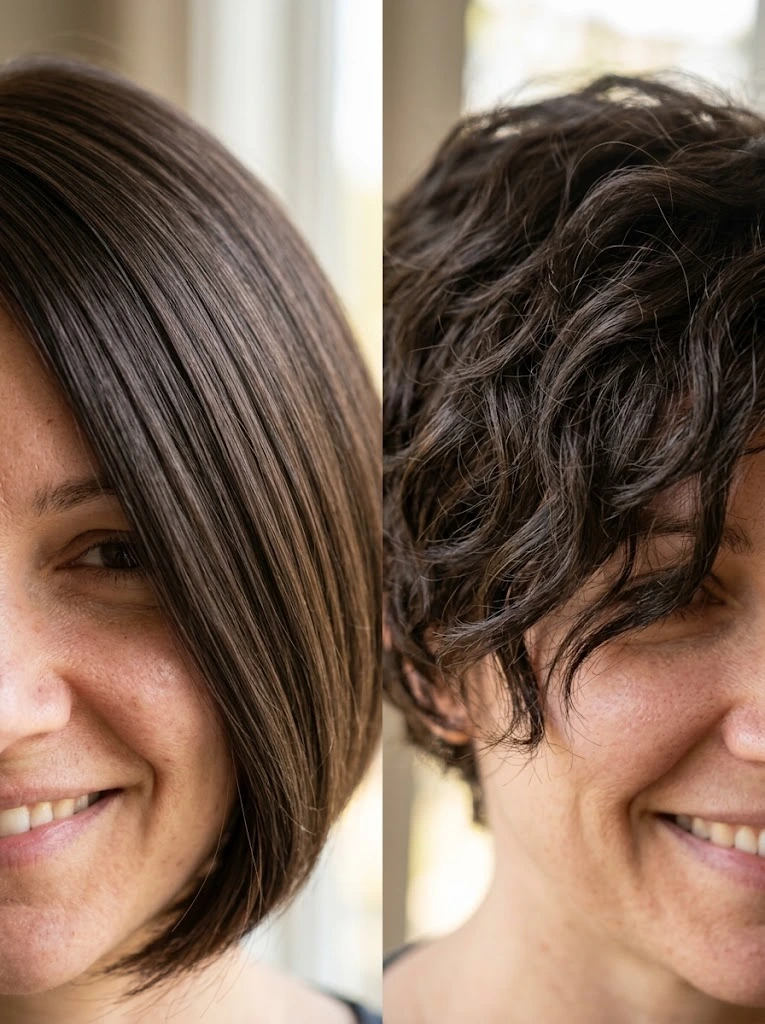
Try both a blunt bob and a softly layered bob. The difference can be more significant than simply changing the length.
Virtual try-on test: compare a chin-length blunt bob with a slightly longer, softly waved version.
- Pixie Cut Wig A pixie is the most dramatic option in this group. Modern pixies range from sleek and tapered to tousled, textured and longer on top.
Best for:
A strong style transformation
People who like visible facial features
Short-hair enthusiasts
Buyers who prefer a compact silhouette
Do not assume “pixie” automatically means zero maintenance. A short wig may still need shaping, product or adjustment to maintain its intended silhouette.
Virtual try-on test: compare a sleek pixie with a textured pixie. They can create very different impressions of structure, softness and volume.
- Layered Short Wig Layers introduce movement and can soften the visual transition between hair and face.
Best for:
Buyers who dislike rigid silhouettes
Casual, textured styling
People who want something between a bob and a pixie
Buyers who want movement without substantial length
A layered crop or bixie can be particularly useful as a bridge between a bob and pixie.
- Short Curly Wig A short curly wig changes the equation because texture creates volume and shape even when the overall length is short.
Try:
- Tight curls
- Loose curls
- Defined waves
- Rounded curly bobs
- Tapered curly crops Do not judge a curly style solely by its front-facing AI image. Curl pattern, density, shrinkage, cap construction and physical styling can materially change the finished look.
How to Use AI Short Wig Try-On as a Decision Tool
A useful virtual try-on should not simply answer, “Does this look pretty?”
It should help answer:
“Which short-wig direction is most compatible with what I actually want to wear?”
Step 1: Upload a Useful Photo
For the strongest comparison, use a photo with:
Your face clearly visible
Even, natural lighting
Minimal or no beauty filter
A relatively straight-on angle
- A neutral expression Enough surrounding head and shoulder area to judge proportions
Avoid using a heavily edited selfie as your only reference.
The goal is not to create the most flattering photograph. It is to create a consistent comparison image.
Step 2: Test More Than One Length
Do not stop after generating one bob.
Try a sequence such as:
14-inch bob → 12-inch bob → bixie → textured pixie
This creates a useful visual progression.
You are looking for the point where the shorter silhouette starts to feel less like “a hairstyle on a model” and more like a hairstyle you could realistically wear.
Step 3: Change One Variable at a Time
If you change length, color, texture and bangs simultaneously, you will not know what caused the difference.
Instead:
Keep the color constant.
Compare bob vs. pixie.
Keep the length constant.
Compare straight vs. wavy.
Keep the style constant.
Compare natural vs. fashion colors.
Then test bangs or different partings.
This turns the AI tool into a controlled visual comparison rather than a collection of random previews.
Short Wig Decision Scorecard
Use this scorecard after your AI try-on rather than choosing solely on appearance.
Score each factor from 1 = poor match to 5 = excellent match.
| Decision Factor | Bob Wig | Pixie Wig | Your Score |
|---|---|---|---|
| Beginner friendly | 5 | 3 |
| Face-framing flexibility | 5 | 3 |
|---|
| Dramatic transformation | 3 | 5 |
|---|
| Everyday styling simplicity | 4 | 4 |
|---|
| Professional versatility | 5 | 4 |
|---|
| Easy transition from long hair | 5 | 2 |
|---|
| Total | 27 | 21 |
|---|
- Score Interpretation 25–30: Strong match. The style aligns well with your stated priorities.
18–24: Worth testing further. Compare another length, texture or silhouette before purchasing.
Below 18: Do not automatically reject the style. Identify which factor is causing the low score and change that variable.
This is a decision aid, not a scientific measurement. A personal styling preference can legitimately outweigh a numerical score.
Example: How the Bob vs. Pixie Decision Can Change
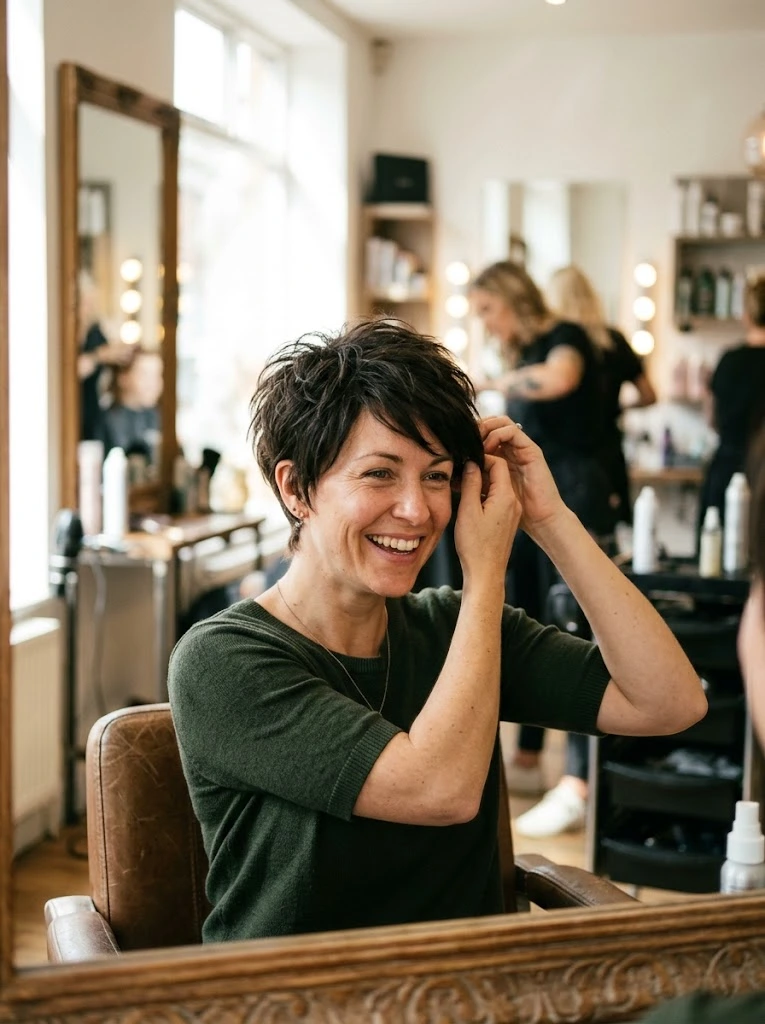
Imagine a first-time buyer who works in an office, normally wears longer hair, wants a visible change and has limited time for morning styling.
She tries three AI previews using the same photograph:
14-inch softly waved bob
- 10-inch textured bob
- Pixie The first reaction is that the pixie looks more dramatic. But when she compares the three images side by side, the longer bob gives her more visible options around the jaw and cheeks, while the pixie makes the haircut itself the dominant feature.
She therefore chooses the bob—not because it is universally more flattering, but because it better matches her stated priorities.
A useful lesson from this scenario is that the strongest visual transformation is not always the strongest buying decision.
Bob vs. Pixie: Which Short Wig Fits Your Lifestyle?
| Feature | Short Bob Wig | Pixie Wig |
|---|---|---|
| Beginner suitability | Excellent | Moderate |
| Style flexibility | Higher | Lower |
| Face framing | More adaptable | More exposed |
| Visual transformation | Moderate | High |
| Daily maintenance | Usually manageable | Can be simple, but shaping matters |
| Professional versatility | High | High, depending on design |
| Transition from long hair | Easier | More dramatic |
| Styling options | More | Fewer |
| Best starting point when uncertain | Yes | Usually test after a bob or crop |
| Choose a Bob If You Want: |
More room to adjust how the hair frames your face
A lower-risk first experience with short hair
A polished everyday silhouette
More options for parting and styling
A gradual transition from long hair
A style that can move between professional and casual settings
Choose a Pixie If You Want:
A stronger transformation
A compact, face-forward silhouette
Less hair around the neck
A deliberately cropped aesthetic
A style that feels distinctly different from your current length
If neither feels right, try a bixie or layered crop. Intermediate short styles give you another option instead of forcing an all-or-nothing decision.
Short Wig Face Shape: Use It as a Starting Point, Not a Rule
Face-shape charts can generate ideas, but they should not dictate your choice.
Two people with an “oval” or “round” face can have very different:
- Forehead proportions
- Cheekbone placement
- Jawlines
- Chin length
- Neck length
- Hairline shapes
- Styling preferences Instead of asking:
“Which wig is correct for my face shape?”
Ask:
“Where do I want the hair to add width, length, softness or structure?”
If You Want More Vertical Emphasis
Experiment with:
- Height at the crown
- Longer top layers
- Side-swept movement
- Elongated bob shapes If You Want Softer Framing
Experiment with:
- Face-framing layers
- Soft waves
- Side fringe Less rigid silhouettes
If You Want Stronger Definition
Experiment with:
-
Blunt bobs
-
Tapered pixies Structured side parts
-
Defined texture The best virtual try-on is the one that helps you compare these variables rather than labeling your face with one “correct” hairstyle.
Real-Wearing Check: Would You Actually Wear This Short Wig?
A hairstyle can look excellent in a static image and still be a poor purchase.
Before choosing, run the real-wearing test.
-
Morning Routine Can you realistically get the wig ready in the time you have before work or school?
-
Commute Will the style remain comfortable during walking, driving or public transit?
-
Heat A short wig may feel less bulky around the neck, but cap construction and fiber still affect how warm it feels.
-
Wind A short, exposed silhouette makes secure fitting particularly important.
-
Maintenance Consider brushing, washing, drying, reshaping and storage—not just how the wig looks immediately after installation.
-
Styling Ask whether you want to restyle it every morning or simply put it on and go.
-
Social Comfort Most importantly:
Would you still choose this style if nobody else had an opinion about it?
That answer can be more useful than a face-shape formula.
Short Wig Density Matters More Than Beginners Expect
Short wigs have less length available to distribute visual density, so an overly full style can look noticeably different from the intended haircut.
When comparing a bob or pixie, inspect:
- Crown volume
- Side volume
- Hairline density How much hair sits above the ears
Whether the ends look intentionally shaped
Whether the style appears too uniform
For a finer-looking style, controlled layering and strategic shaping can create movement and the appearance of fullness without simply adding more hair.
This is another reason to use AI as a silhouette test rather than assuming that the physical wig will reproduce every detail of the preview.
Should You Choose Synthetic or Human Hair for a Short Wig?
Your intended use matters more than the label.
-
Synthetic Short Wig Consider it if you want:
-
Lower initial cost
-
A ready-made style Consistent curl or shape
-
Less daily restyling A lower-risk way to experiment
A synthetic pixie can make particular sense for a first experiment because the shorter design does not require long lengths to demonstrate the haircut.
Watch for: fiber sheen, density, heat sensitivity and whether the wig is heat-friendly.
- Human Hair Short Wig Consider it if you want:
Greater styling flexibility
A more customizable finish
The ability to change texture or parting
A longer-term investment
Watch for: higher cost, maintenance requirements and the possibility that premium fiber will not solve a poor cap fit or unsuitable silhouette.
[Compare synthetic and human-hair wig considerations →]
- Budget Guardrail If your budget is under $150, do not assume human hair is automatically the better decision. For a first-time short-wig experiment, a well-constructed synthetic or heat-friendly synthetic wig may provide better value for testing the haircut itself.
Commission Blind Test: this recommendation would remain the same if affiliate commission were zero.
How to Make an AI Short Wig Preview More Useful
Use the same photograph for every comparison.
Then create a simple test set.
-
Test A — Length Bob vs. bixie vs. pixie.
-
Test B — Texture Straight vs. soft wave vs. curly.
-
Test C — Fringe Open forehead vs. side fringe vs. bangs.
-
Test D — Color Your familiar shade vs. one lighter option vs. one darker option.
-
Test E — Hairline Compare the visual effect of an exposed front against a style with more coverage.
Do not ask the AI result to answer all five questions at once.
Change one variable. Compare. Record your reaction. Repeat.
That produces better decision information than endlessly generating unrelated hairstyles.
A Better Short-Wig Buying Sequence
If your goal is to reduce the risk of buying the wrong wig, follow this order:
- Decide the Silhouette
Bob, bixie, pixie or cropped style.
- Decide the Approximate Length
Do not start with color.
- Choose the Texture
Straight, wave or curl.
- Evaluate Face Framing
Look at cheeks, jawline, forehead and neckline.
- Choose the Color
Once the shape works, test color.
- Check Physical Specifications
Verify:
- Cap circumference
- Cap construction
- Fiber
- Density
- Lace type
- Parting construction
- Weight
- Adjustability [Check your wig cap size before buying →]
- Check the Return Policy
A virtual preview should reduce uncertainty, not eliminate the need for a sensible return-policy check.
- Buy Only After the Visual and Physical Checks Agree
This is where an AI preview becomes genuinely useful: it narrows the field before you spend money.
[Use the short wig buying checklist →]
Short Wig Try-On FAQs
- Which short wig style suits a round face?
There is no single universally correct short wig for a round face. If you want more visual length, experiment with a bob that extends below the widest part of the cheeks, asymmetry or controlled height at the crown.
Use the AI preview to compare where the wig's width begins and ends relative to your cheeks and jaw rather than relying on a generic face-shape chart.
- Is a bob or pixie better for a first-time wig buyer?
For most uncertain first-time buyers, a bob is the lower-risk starting point because it provides more face-framing flexibility and makes the transition from longer hair less dramatic.
A pixie becomes a stronger choice when you already know that you enjoy cropped silhouettes and want a more pronounced transformation.
- Are short wigs easier to maintain than long wigs?
Often, yes—but not automatically.
Short wigs generally have less length to detangle and can dry faster. However, a highly structured pixie may require more precise shaping than a simple bob. Fiber type, density and styling design can matter as much as length.
The better question is:
“How much daily styling does this specific wig require?”
- Can I compare short and long wigs with AI?
Yes. This is one of the most useful comparisons to make.
Try:
Long style → lob → bob → bixie → pixie
Using the same photo makes the visual difference easier to evaluate.
You may discover that you like the effect of shorter hair without actually wanting an ultra-short cut.
- Can AI tell me whether a wig will look natural?
Only partially.
It can help you evaluate the visual direction of the hairstyle, but it cannot verify physical lace quality, cap fit, knot appearance, fiber behavior or how the wig will look under different lighting and movement.
For a natural-looking result, treat AI as the first filter—not the final inspection.
- Does a lace-front wig always look more natural?
No.
A lace front can provide a more natural-looking exposed hairline when properly designed and fitted, but the final result also depends on:
- Lace quality
- Lace color
- Density
- Knot visibility
- Hairline design
- Fit
- Placement
- Customization
- Lighting A poorly fitting lace front can look less convincing than a well-designed non-lace style that intentionally covers the hairline.
[Learn more about Lace Front wig construction →]
- Is a short wig good for everyday wear?
It can be excellent for everyday wear if the cap, density, fiber and styling requirements match your routine.
Before buying, consider your commute, climate, work environment, desired styling time and comfort over several hours—not just the first five minutes in the mirror.
- Can I use AI try-on to choose between a bob and pixie?
Yes. That is one of the strongest use cases.
Rather than asking which one is universally “more flattering,” compare:
-
Overall silhouette
-
Face framing
-
Visual impact Professional versatility
-
Styling preference Comfort with the degree of change
Then check the physical specifications of your preferred option before buying.
- How do I know if a short wig will look natural on me?
Start by checking whether the silhouette, density and hairline placement look believable—not simply whether the AI has produced a flattering image.
Use a consistent, unfiltered photo and compare the same style under several views if your try-on tool supports them. Then verify the physical wig's cap construction, density, lace, fiber and return policy.
A natural-looking result comes from the combination of appropriate design + correct fit + realistic density + suitable hairline construction, not from the hairstyle alone.
- Can I use AI to compare different short-wig textures?
Yes, and you should.
Compare straight, soft wave, defined curls and textured layers while keeping the length and color as consistent as possible.
Texture changes the apparent volume and silhouette of a short wig, so a 12-inch straight bob can look substantially different from a 12-inch curly bob even when the nominal length is the same.
The most useful comparison is therefore:
Same face + same approximate length + different texture.
That tells you whether you actually prefer the texture or are simply reacting to a different haircut.
Your Short-Wig Decision: Preview First, Purchase Second
The smartest reason to use an AI short wig try-on is not to get a perfect digital version of your future hair.
It is to remove avoidable uncertainty.
Start with a bob if you want a lower-risk introduction to short hair. Move toward a bixie or pixie when you know you want more dramatic cropping. Test texture and color separately, and never let a virtual image replace checking cap measurements, construction, fiber, density and return terms.
Most importantly, do not choose a short wig simply because an algorithm says it suits your face.
Choose the style that looks right and fits the way you actually want to live.
Ready to compare your bob, bixie and pixie options?
[Start Short Wig Try-On →]
Editorial Evidence & AI Limitation Notice
Evidence classification: Level B — Expert Review + Current Industry Sources.
Professional styling coverage continues to show substantial variation within the pixie category, reinforcing that “pixie” is not one fixed silhouette. The final effect can change considerably with length, layering, texture and styling.
AI hairstyle-transfer research identifies challenges involving pose differences and areas of the original image that become hidden when long hair is transformed into short hair. Accordingly, WigMirror treats virtual try-on results as secondary visual validation, not a guarantee of physical wig appearance, fit or performance.
Privacy governance: Any photo-based try-on should require user consent, use anonymous data where possible and follow a raw-image-retention policy of false. Users should not be required to surrender permanent storage of personal photographs simply to explore a hairstyle.
Editorial Independence & Affiliate Disclosure
WigMirror may receive commissions when readers purchase through qualifying affiliate links. This does not change our decision criteria, and recommendations are intended to remain the same regardless of commission amount. The FTC advises websites using affiliate relationships to disclose material connections clearly and conspicuously so readers can evaluate recommendations appropriately.
Last reviewed: August 13, 2026 Next review: November 13, 2026