

Try On Wigs for Oval Faces: Best Styles & Buying Guide
🛡️ Editorial Independence & Transparency Notice: WigMirror is an independent wig decision-advice platform. Recommendations are based on styling, construction, comfort, maintenance, and real-world use—not on which product generates the highest commission. If you purchase through an affiliate link, we may earn a commission at no additional cost to you. Prices, inventory, and specifications can change.
Quick Decision Answer
If you have an oval face, you can wear a wide range of wig lengths, textures, parts, and cuts. Your face shape is best treated as a styling reference—not something that needs to be “corrected.”
For a dependable starting point, try a 16–18 inch body-wave wig with medium density. It offers movement, enough length for face-framing layers, and a manageable everyday silhouette. But if you prefer short hair, low-maintenance styling, strong curls, or a sleek professional look, a bob, lob, curly unit, or straight wig may be a better match.
Want to see the difference before buying? Try on wigs with AI and compare styles on your own photo.
Quick Selection Matrix
| Your Priority | Best Starting Choice | Consider Avoiding | Key Advantage |
|---|---|---|---|
| First wig | 16–18" body wave, medium density | Very long, high-density units | Versatile and manageable |
| Low maintenance | 10–14" bob or 14–16" straight wig | Long curls | Less detangling |
| Natural-looking hairline | Well-fitted lace front | Excessively dense front | More hairline flexibility |
| Fast installation | Glueless wig | Adhesive-dependent construction | Easier on/off routine |
| Polished professional look | Straight lob or sleek bob | Unwanted high-volume texture | Clean silhouette |
| Loves texture | Curly or deep-wave wig | A straight style you dislike | Expressive movement |
| Frequent restyling | Human hair | Heat-sensitive synthetic hair | More styling flexibility |
| Hot climate | Shorter bob/lob, moderate density | Heavy, long hair | Less heat and neck coverage |
| Tight budget | Shorter synthetic wig | Premium human hair by default | Lower purchase cost |
  |
|||
| See the Difference Before You Buy |
AI try-on is most useful as a visual screening step. You can compare a short bob with 18-inch waves, a middle part with a side part, or straight hair with curls before narrowing your choices.
A typical workflow is:
Upload a photo → select styles → compare silhouettes → shortlist favorites → verify the physical specifications before buying.
The tool can help answer “Do I like this look?” It cannot reliably answer “Will this cap fit?” or predict the exact weight, lace feel, heat retention, tangling, or long-term durability of a physical wig.
Start your AI wig try-on .
The Best Starting Wig for an Oval Face: 16–18-Inch Body Wave
If you want one practical starting point, choose 16–18 inches, body wave, and medium density.
Why this combination works
16–18 inches gives you enough length for:
Soft face-framing layers
- Loose waves Casual and dressed-up styling
A noticeable transformation without extreme length
Body wave adds movement without the stronger visual commitment of tight curls. It can look polished without requiring elaborate styling.
Medium density gives enough fullness for waves and layers without automatically creating a heavy silhouette.
A lace front can provide flexibility around the visible hairline and part, but lace alone does not guarantee realism. Cap fit, front density, lace color, knot visibility, hairline placement, and styling all matter.
The key point is simple: an oval face does not require visual correction. You do not need bangs, side volume, or extra length simply because a face-shape chart recommends them.
Body wave is simply a useful middle ground.
For more styling ideas, see the wig face-shape styling guide .
When 16–18 Inches Is the Sweet Spot
Choose this range if you want:
A versatile everyday wig
Enough length for soft face-framing
Moderate styling flexibility
A balance between visual impact and manageable weight
A look that can move from work to weekends
Choose 16 Inches If:
You commute frequently
You live in a warm or humid climate
You dislike hair sitting on your neck
You want faster detangling
You prefer a lighter feel
Choose 18 Inches If:
You enjoy longer layers
You want more movement around the shoulders
You regularly style your hair for events
You are comfortable with additional maintenance
If you are uncertain, try both lengths virtually before deciding.
Who Should NOT Buy the Default 18-Inch Body-Wave Wig?
The default recommendation is a starting point—not a universal answer.
Skip it if:
You strongly prefer short hair. A 10–14 inch bob may feel more natural.
You want minimal maintenance. Longer waves usually need more detangling.
You live in a hot or humid environment and dislike hair on your neck. A bob or shorter lob may be more comfortable.
You need a highly structured professional appearance. A sleek bob or straight lob may fit better.
You dislike waves. Do not buy body wave simply because it is considered versatile.
You want frequent heat restyling. Human hair may make more sense if the cost and maintenance fit your budget.
You normally wear very full hair. Medium density may feel too restrained.
Your budget is tightly limited. A shorter, simpler unit can reduce purchase and maintenance costs.
You dislike detangling. Long textured hair can create more daily work.
The cap does not fit correctly. A flattering silhouette cannot compensate for an uncomfortable wig.
The best wig is the one you will actually wear.
Oval Face Shape: Use It as a Styling Reference, Not a Rulebook
Oval faces are commonly described as relatively balanced, with the face generally longer than it is wide and with gently rounded contours. That makes the shape versatile, but real faces are not geometric templates.
You may have an oval face with:
-
A higher forehead
-
Prominent cheekbones
-
A stronger jawline
-
A softer chin
-
A widow's peak A high or low hairline
-
Natural asymmetry Those details can matter more to your final wig choice than the label “oval.”
Two people with broadly similar face proportions can therefore prefer completely different wigs. One might want curtain bangs and a side part; another might prefer a clean middle part with an open forehead.
Use face shape to narrow your options—not to eliminate styles you genuinely like.
Middle Part or Side Part for an Oval Face?
Both can work.
Choose a Middle Part If You Want:
-
Symmetry A clean, modern appearance
-
An open forehead A simple everyday look
A style that emphasizes balanced proportions
A middle part can look particularly effective with loose body waves, long layers, or sleek straight hair.
Choose a Side Part If You Want:
- More asymmetry
- A softer appearance More apparent volume on one side
A change from your normal center part
A style closer to your natural styling habits
The practical question is not which part is theoretically “best.”
Ask instead:
Does the cap support the part I want?
Does the part sit naturally on my head?
Does the hairline look believable?
Does the part match my everyday styling?
Can I change the part without creating obvious gaps or unnatural density?
Use the AI wig try-on tool to compare a middle part and side part before committing.
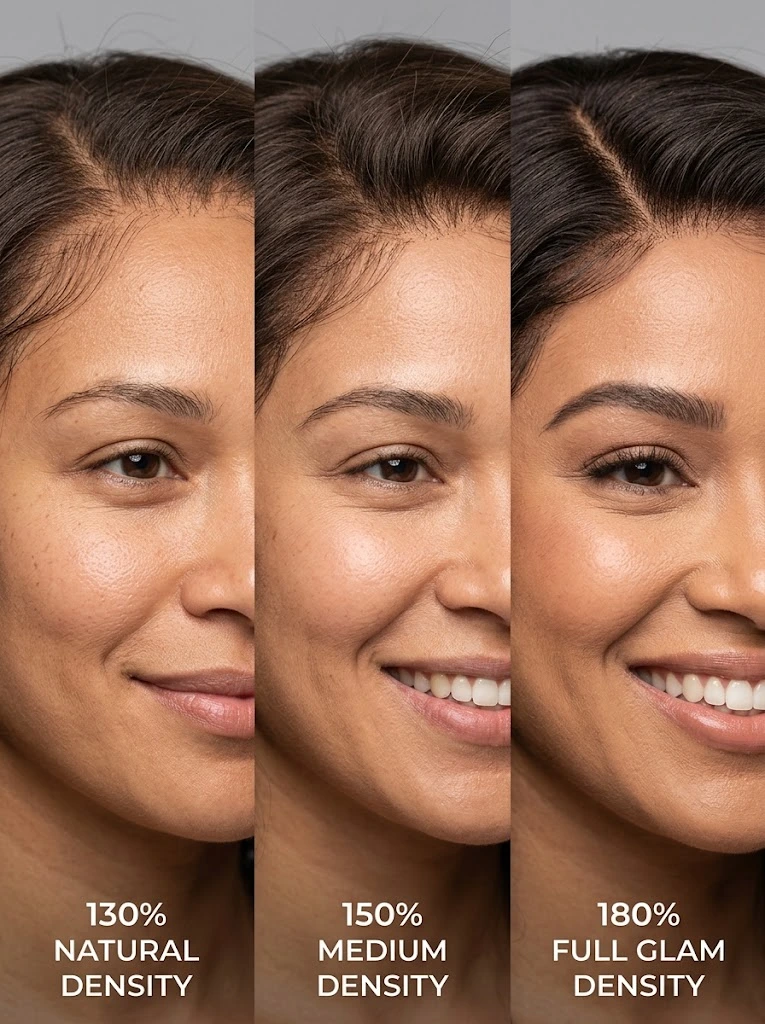
How Much Density Should an Oval-Face Wig Have?
Density affects the overall silhouette more than many first-time buyers expect.
- Low Density Best for: lightweight, close-to-the-head looks.
It can feel comfortable and natural, but may not provide enough fullness for large curls or dramatic styling.
- Medium Density Best for: most everyday buyers.
It offers a useful balance of fullness, movement, and control. For an oval face, that flexibility makes it a practical starting point.
- High Density Best for: fuller, glamorous, or highly styled looks.
The trade-off is more weight, more detangling, and potentially more heat.
Density percentages also vary between manufacturers. Treat labels such as “150%” or “180%” as product-specific specifications rather than universal measurements.
Match the density to the fullness you actually enjoy wearing.
Body Wave vs. Straight vs. Curly Wigs for Oval Faces
- Body Wave Best for: versatility and soft movement.
Choose it when you want:
-
Moderate volume Casual-to-polished versatility
-
Softness Face-framing movement
-
Straight Best for: sleek outfits, clean lines, and controlled styling.
Straight hair can emphasize facial length, but that is not automatically undesirable for an oval face.
If you want more movement, consider:
- Face-framing layers
- A side part A soft bend through the ends
A shoulder-length lob
- Curtain bangs
- Curly Best for: texture, volume, and expressive styling.
Curly wigs can look excellent on oval faces. The more important questions are curl pattern, density, volume placement, and maintenance.
If you love curls, choose curls because they fit your personal style—not because a face-shape chart approves them.
Compare body-wave, straight, and curly wig options before narrowing your choice.
Can Oval Faces Wear Bobs?
Absolutely.
A bob can be an excellent alternative to a long body-wave wig when you want a sharper, more structured look.
- Chin-Length Bob A chin-length bob creates a strong horizontal line and can feel crisp and fashion-forward.
It suits buyers who enjoy:
-
Structured outfits
-
Sleek styling
-
A defined silhouette Less daily detangling
-
Shoulder-Length Lob A lob is the middle ground between a bob and long hair.
It offers:
More movement than a short bob
Less maintenance than long hair
Enough length for soft waves
Easy everyday styling
- Layered Bob A layered bob adds movement without requiring substantial length. It is useful if you want shorter hair but dislike a completely blunt shape.
What Wig Length Is Best for an Oval Face?
There is no single best length. Use your lifestyle to narrow the choice.
| Length | Best For | Main Trade-Off |
|---|---|---|
| 8–10" | Cropped styles and short bobs | Less styling versatility |
| 10–14" | Bobs and low-maintenance wear | More structured silhouette |
| 14–16" | Everyday versatility | Less dramatic than long hair |
| 16–18" | Waves, layers, and general versatility | Moderate maintenance |
| 20–24" | Long, noticeable styles | More weight and detangling |
| 24"+ | Statement-length looks | Highest maintenance burden |
The same length can look completely different depending on density, curl pattern, layers, and where the hair begins framing the face.
If you are deciding between two lengths, try them virtually first.
Lace Front vs. Glueless Wig for an Oval Face
Face shape does not determine whether you need a lace front or glueless construction.
These are primarily hairline, installation, and convenience decisions.
Choose a Lace Front When:
Hairline realism is a major priority
You want the appearance of hair emerging from the front
You want greater front-styling flexibility
You are comfortable learning lace preparation and maintenance
A lace front is not automatically more natural. Poor fit, excessive front density, visible knots, unsuitable lace color, or incorrect placement can undermine the effect.
Choose Glueless When:
Convenience matters more than maximum customization
You want a faster morning routine
You prefer not to use adhesive
You want an easier on/off process
You remove the wig frequently
For many beginners, glueless convenience is more valuable than installation complexity.
See the glueless vs. lace-front wig guide if installation is your main concern.
Human Hair vs. Synthetic for an Oval Face
Your face shape does not determine the fiber you need.
Choose Synthetic If You Prioritize:
- Lower upfront cost Minimal daily styling
A pre-set wave or curl
Fast morning preparation
- Consistent styling A good synthetic wig can be an excellent choice when convenience matters more than customization.
Choose Human Hair If You Prioritize:
- Frequent restyling Heat styling flexibility
Greater control over the final hairstyle
A highly customizable routine
Human hair generally brings a higher purchase and maintenance commitment. It is not automatically better simply because it costs more.
- Decision Rule If your goal is “put it on and go,” start with a well-made synthetic option.
If your goal is “style it differently every week,” human hair deserves stronger consideration.
What About Bangs on an Oval Face?
Bangs are optional—not corrective equipment.
- Curtain Bangs Useful if you want:
Soft forehead framing
Movement around the temples
A less rigid center-part look
-
Side-Swept Bangs A good option if you prefer asymmetry or more styling around one side of the face.
-
Blunt Bangs A stronger fashion statement that can substantially change the character of a wig.
-
No Bangs Often the cleanest option if you like an open forehead and want the hairline or part to remain prominent.
If you are buying bangs because you think an oval face requires them, reconsider. It does not.
How to Choose the Hairline and Cap
A flattering hairstyle can still feel wrong if the cap does not fit.
- Check Cap Size
Measure your head according to the retailer's instructions rather than assuming an average cap will fit.
- Check Hairline Position
Compare the wig's front hairline with your own proportions.
A lace front that sits too far forward can look less natural regardless of face shape.
- Check Front Density
A very dense hairline can look less believable than a softer transition. More hair does not automatically mean better coverage.
- Check Part Construction
If you want to switch between middle and side parts, make sure the construction supports that flexibility.
- Check Comfort Features
For everyday wear, consider:
-
Adjustable straps Breathable construction
-
Ear tabs
-
Interior seams Combs or clips when appropriate
Glueless construction
- Overall cap weight Real-Wearing Considerations: The Wig Has to Work at 8 A.M., Not Just in a Photo
A wig can look excellent in a product photograph and still be the wrong purchase for your routine.
-
If You Commute Prioritize:
-
Secure fit
-
Moderate length Low-to-moderate density
-
Easy morning styling
-
Minimal tangling If You Live in Heat or Humidity
Prioritize:
-
Shorter lengths Breathable construction
-
Manageable density Styles that do not require constant smoothing
If You Have a Five-Minute Morning Routine
A pre-styled synthetic wig or simple glueless unit may be more appropriate than a human-hair wig that requires daily styling.
If You Regularly Change Hairstyles
Human hair or a suitably versatile wig may justify the extra investment.
If You Remove Your Wig Every Night
Glueless construction can become particularly attractive because installation convenience compounds over time.
Experience level: Beginner-friendly. Choose the cap and fiber according to how often you realistically want to install, style, clean, detangle, and store the wig.
A Simple Decision Tree for Buying a Wig for an Oval Face IF YOU WANT THE SAFEST EVERYDAY START
Choose:
16–18" + body wave + medium density + a cap construction you can comfortably maintain.
IF YOU WANT LOW MAINTENANCE
Choose:
10–16" + straight or pre-styled wave + moderate density + synthetic fiber.
IF YOU WANT A SHARP PROFESSIONAL LOOK
Choose:
A sleek bob or lob + controlled density + straight texture.
IF YOU WANT MAXIMUM TEXTURE
Choose:
Curly or deep-wave hair + density appropriate to the curl pattern + enough time for maintenance.
IF YOUR PRIORITY IS HAIRLINE REALISM
Focus on:
Cap fit + front density + lace quality + hairline placement + appropriate styling.
Do not judge a wig by the term “HD Lace” alone.
IF YOUR PRIORITY IS FAST INSTALLATION
Choose:
A well-fitting glueless construction.
Do not pay for installation complexity you do not intend to use.
IF YOU HAVE A STRICT BUDGET
Prioritize:
-
Correct cap fit
-
Wearable density
-
Suitable length Fiber appropriate to your routine
-
Hairline appearance A more expensive fiber cannot rescue a wig that is uncomfortable or impractical.
How to Use AI Try-On Without Letting It Make the Buying Decision
AI try-on is most useful as a visual screening tool.
- What You Can Compare Use the tool to preview:
Short versus long lengths
- Bob versus lob Middle versus side parts
Straight versus wavy texture
Bangs versus no bangs
Different overall silhouettes
What the Preview Cannot Reliably Tell You
A virtual image cannot reliably predict:
Whether the cap will fit
How heavy the wig will feel
Whether the lace will match your skin tone
How the wig will behave in humidity
Whether the hair will tangle
How much daily maintenance it will require
Whether the stated density matches your expectations
Whether the seller's specifications are accurate
A Better Decision Workflow
Step 1: Upload a clear photo you are comfortable using.
Step 2: Compare several genuinely different styles rather than dozens of minor variations.
Step 3: Shortlist two or three looks you would realistically wear.
Step 4: Check the actual wig's cap size, length, density, fiber, construction, and return policy.
Step 5: Make the purchase decision using both visual preference and real-world requirements.
Use AI try-on to answer:
“Do I like this visual direction?”
Then use product specifications and lifestyle considerations to answer:
“Should I actually buy it?”
AI Try-On Demo: What You Are Actually Evaluating
The most useful comparison is not a single “before and after” image. Test the variables that can materially change the silhouette:
16" body wave → 18" body wave → 14" lob → straight bob
Then compare:
Where the hair begins framing your face
How much volume appears beside the cheeks
How the length changes the overall impression
Whether a middle or side part feels more natural
Whether bangs change the look in a way you actually prefer
This makes AI try-on a shortlisting tool rather than an automated purchasing decision-maker.
How Private Is the Try-On?
WigMirror's privacy baseline is:
Consent required: Yes
Anonymous data where possible: Yes
Raw image retention: No
The decision framework is designed around not retaining the raw uploaded image after the try-on process unless a separate, clearly stated user choice permits storage for a specific purpose.
There is intentionally no blanket accuracy percentage presented here. AI try-on performance can vary with photo quality, lighting, face angle, hair visibility, image processing, and the specific style being rendered. A precise accuracy claim would be misleading without a defined test set, methodology, sample size, and current results.
Try the oval-face wig AI preview and use it to narrow your options before checking the physical specifications.
Three Wig Profiles Worth Comparing Before You Buy
Instead of searching for one supposedly perfect “oval-face wig,” compare these three profiles.
Profile A: The Everyday All-Rounder
16–18" body wave · medium density · lace front or easy glueless construction
Best for:
- First-time buyers
- Work and casual wear
- Moderate styling Buyers who want one versatile wig
Trade-off: not the lightest or lowest-maintenance option.
Profile B: The Low-Maintenance Commuter
10–14" bob/lob · straight or pre-styled wave · moderate density · synthetic
Best for:
- Busy mornings
- Hot climates
- Frequent commuting Buyers who dislike detangling
Trade-off: less dramatic styling flexibility.
Profile C: The Styling Enthusiast
18–24"+ human hair · layered or textured · adjustable parting where supported
Best for:
- Frequent restyling
- Event styling Buyers who value customization
People comfortable with higher maintenance
Trade-off: higher purchase cost and more styling work.
What to Check Before You Click Buy
Is the length appropriate for my actual routine?
Do I genuinely like the texture?
Is the density close to the look I normally wear?
Does the cap size match my measurements?
Does the construction support my preferred part?
Do I actually need a lace front?
Would glueless construction make my routine easier?
Is the fiber appropriate for how often I want to restyle?
Can I tolerate the weight and heat?
Does the hairline look believable from multiple angles?
Have I checked the return policy before altering the wig?
Am I choosing this style because I like it—or because a face-shape chart told me to?
FAQ: Wigs for Oval Faces
- What is the best wig style for an oval face?
A 16–18 inch body-wave wig with medium density is a strong starting point because it balances length, movement, and everyday manageability. However, oval faces can accommodate many styles, so your preferred texture and lifestyle should ultimately decide.
- Can oval faces wear short wigs?
Yes. Bobs, lobs, layered cuts, and very short styles can all work. If you prefer low maintenance, a short wig may actually be a better choice than long waves.
- Are long wigs good for oval faces?
Yes. Long straight, wavy, and curly wigs can all work. The main trade-offs are weight, heat, tangling, and maintenance rather than face-shape compatibility.
- Is a middle part or side part better for an oval face?
Neither is universally better. A middle part emphasizes symmetry, while a side part introduces asymmetry and can change the character of the style.
- Can an oval face wear a bob?
Absolutely. A chin-length bob can create a crisp, structured look, while a lob provides more movement and styling flexibility.
- Do oval faces look better with bangs?
Not necessarily. Oval faces can accommodate curtain, side-swept, blunt, wispy, or no bangs. Choose bangs because you like the look, not because you believe you need to alter your proportions.
- Is body wave better than straight hair for an oval face?
Not inherently. Body wave adds movement and is a versatile default, while straight hair creates a cleaner, sleeker silhouette. Both can suit an oval face.
- What wig density is best for an oval face?
Medium density is a practical starting point for everyday wear because it provides fullness without automatically creating a heavy silhouette. Your natural hair density and preferred hairstyle should also influence the decision.
- Is a lace-front wig better for an oval face?
Not because of face shape. Lace-front construction is mainly relevant to hairline appearance and styling flexibility. A well-fitting glueless wig can be better if convenience is your priority.
- Is synthetic or human hair better for an oval face?
Face shape does not determine the fiber. Synthetic hair is often better for low-maintenance, pre-styled wear, while human hair is more appropriate when frequent restyling and heat styling are important.
- How accurate is AI wig try-on?
AI try-on can help compare the visual direction of different styles, but it is not a physical fit test. It cannot reliably predict cap comfort, actual density, weight, lace behavior, tangling, or performance in humidity.
- Use AI try-on to shortlist styles, then verify the actual specifications before purchasing.
- Does WigMirror store my photo after AI try-on?
The WigMirror privacy baseline is raw image retention: false. Consent should be required, with anonymous data used where possible. Review the specific privacy notice presented in the try-on experience before uploading a photo.
- Can AI tell whether I have an oval face?
AI can estimate facial landmarks and proportions from an image, but face-shape classification is not perfectly objective. Lighting, camera angle, expression, hairline visibility, and image quality can affect the result.
Treat the classification as a styling aid rather than a definitive measurement.
- Should I choose a wig specifically labeled “for oval faces”?
Not necessarily. Product labels can help with discovery, but the more useful specifications are length, density, texture, cap size, construction, hairline, and maintenance requirements.
- What should I avoid when buying a wig for an oval face?
Avoid buying a style solely because a face-shape guide calls it “flattering.” Also avoid incorrect cap sizing, excessive density you will not enjoy wearing, unnecessary installation complexity, and textures that do not match your personal style.
- Can I use AI try-on to choose between a bob and 18-inch waves?
Yes. That is one of the more useful applications of virtual try-on. Compare both silhouettes on the same photo, then make the final decision using cap construction, maintenance, budget, and comfort requirements.
The Bottom Line: Choose the Wig for Your Life, Not Just Your Face Shape
An oval face gives you a broad styling canvas, but that does not make every wig equally suitable.
If you want a dependable starting point, 16–18 inches, body wave, and medium density is a sensible combination because it balances movement, versatility, and manageable maintenance.
But a shorter bob may be smarter if you commute in heat. A sleek lob may fit a polished wardrobe better. A curly unit may be the obvious choice if texture is central to your style. And a glueless synthetic wig may be a better investment than an expensive human-hair lace unit if your real priority is getting ready quickly.
Choose your face shape as a reference. Choose your wig based on the life you actually live.
Final Recommendation Guardrail
If affiliate commission were zero, would the recommendation remain the same?
Yes. The 16–18 inch body-wave recommendation is a starting-point profile based on versatility and practical wear considerations, not retailer commission or brand preference.
Who should avoid the default recommendation?
Buyers who prioritize very short hair, extremely low maintenance, very high volume, intense curl definition, hot-weather comfort, or frequent custom restyling should evaluate other profiles first.
Editorial Evidence & Transparency
Evidence level: Level B — expert-informed editorial synthesis.
Face-shape styling should be treated as a flexible reference rather than a strict prescription. Wig-specific decisions also depend on cap construction, measurements, density, fiber, texture, and maintenance requirements.
Density percentages vary between manufacturers and retailers, so labels such as “150%” or “180%” should be evaluated alongside the seller's actual specifications, photographs, and construction details.
For affiliate relationships, the FTC advises that material financial connections should be disclosed clearly and conspicuously so readers can understand the relationship when evaluating recommendations. FTC Endorsement Guides
Privacy governance: consentRequired: true · anonymousDataOnly: true · rawImageRetention: false
🛡️ FTC Affiliate Disclosure: If you purchase through an affiliate link on this page, WigMirror may receive a commission at no additional cost to you. Affiliate relationships do not determine our editorial recommendations. We apply the same decision criteria regardless of commission status. This disclosure is provided so the commercial relationship is clear to readers, consistent with FTC guidance.